

Workbooks & sheets
A workbook is the container for one body of work: its documents, its sheet and the results built on top of them (presentations and dashboards). Workbooks live inside your organization, and the Home screen greets you with a grid of the workbooks you have access to.
Create a workbook
From Home, click New workbook. The Create Workbook modal asks for:
- Workbook Name — at least 3 characters. Names are checked for uniqueness as you type; if it exists you see "This name is already taken".
- Description — optional context for your team.
- Workbook Avatar — either Generate Avatar (a colorful gradient) or Upload Image (JPEG, PNG or WebP, up to 5 MB).
- Folder — place the workbook in an existing folder, create a new one on the spot, or keep it at root level.
Organize with folders
Folders keep large workspaces tidy:
- Folders can contain subfolders, so you can build a hierarchy (for example by client, then by year).
- Move workbooks between folders at any time.
- Deleting a folder offers a cascade choice — Move workbooks to root (recommended) keeps the workbooks and removes only the folder.
The All workbooks view lists everything regardless of folder.
The sheet
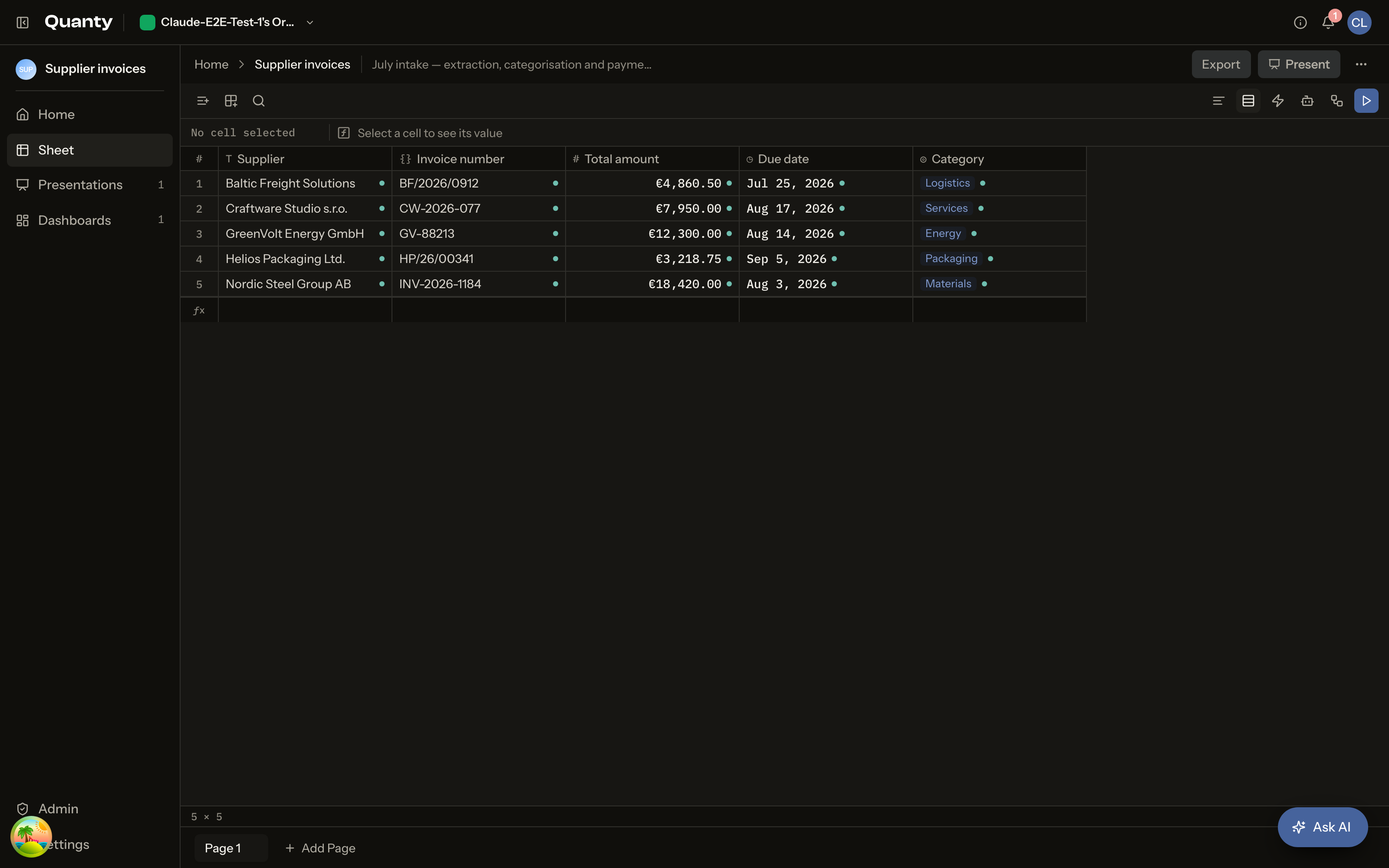
Each workbook has one sheet — the main workspace where documents meet AI columns. Open it from the workbook card; the grid supports Excel-style editing, range selection and formulas (see Formulas & Excel mode).
Pages
A sheet is split into Pages — tabs along the top of the grid, like worksheet tabs in Excel:
- New sheets start with Page 1.
- Use Add Page to create more tabs; each page has its own rows.
- Pages can be renamed, duplicated (structure and data) and deleted.
Columns are defined per page, so different pages can model different shapes of data inside the same workbook.
Rows
Rows are where your data enters the sheet. A row can come from:
- Files — add documents from your Files library or upload new ones; each file becomes a row and AI columns read it.
- Text entries — free-text rows for data that is not a document.
- Blank rows — empty rows you fill by hand or with formulas.
You can reorder rows, delete them one at a time or in batches, and attach additional reference files to a row.
Sub-sheets
A Sub-sheet column holds a nested sheet inside a cell — the right shape for one-to-many data, such as the line items of an invoice. Sub-sheets open as full sheets with a breadcrumb back to the parent, so you never lose your place. Sub-sheet columns define Sub-columns (text, number or computed) that AI fills per item. See Columns & AI extraction for how to configure them.
Presentations and dashboards
Each workbook carries its own Presentations and Dashboards, listed in the workbook's sidebar. They are generated from the sheet and stay linked to it — you can regenerate them as data changes. See Presentations & dashboards.
Members and roles
Workbooks have their own member list on top of organization membership:
- Organization owners and admins can add members to a workbook and manage their roles.
- A workbook contributor can access the workbook, view and edit its sheet and library content.
- Workbook owners and admins manage settings and membership.
Organization-wide roles still apply: a Viewer has read-only access everywhere. See Organizations & roles.
Export
The sheet can be exported as CSV or Excel at any time — useful for handing results to someone outside Quanty. Presentations and dashboards can also be shared directly by public link instead of exporting raw data.
Next steps
- Files & Knowledge Base — get documents into the workbook.
- Columns & AI extraction — define what the AI should extract.
- Chat — let the assistant build and edit the sheet for you.