

Integrations
The Integrations hub connects Quanty to the tools your data already lives in. Today that means Gmail for email ingestion, Google Sheets for two-way spreadsheet syncs and the AI Secretary that answers your phone; more connectors are on the roadmap. Open the hub from the sidebar.
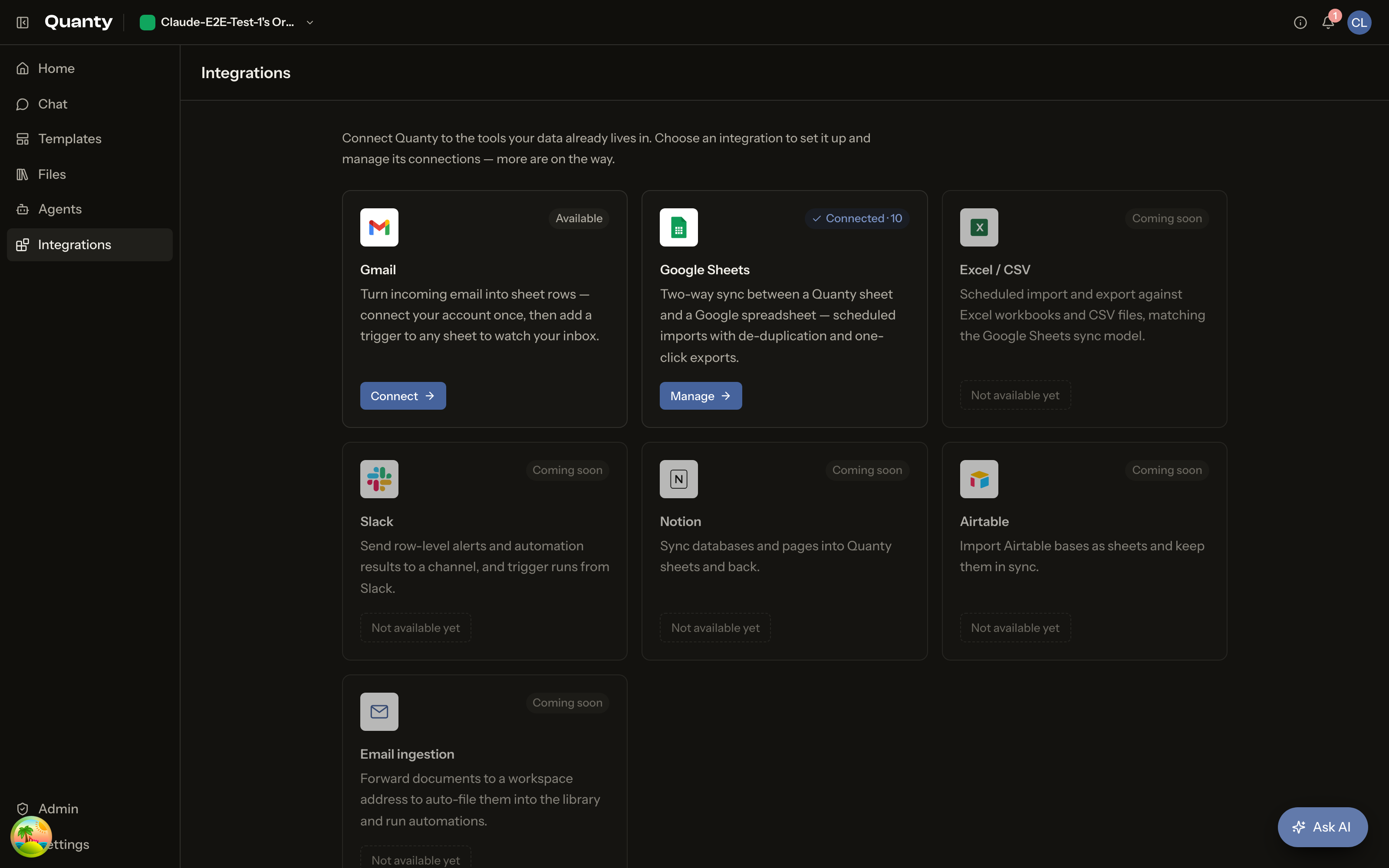
The integrations catalog
Each integration card shows a status chip and the matching action:
| Integration | Status | Actions |
|---|---|---|
| AI Secretary | Connected or Available | Manage |
| Gmail | Connected or Available | Manage, Connect, Reconnect, Disconnect |
| Google Sheets | Available | Set up, Manage |
| Excel / CSV | Coming soon | — |
| Slack | Coming soon | — |
| Notion | Coming soon | — |
| Airtable | Coming soon | — |
| Email (forwarding) | Coming soon | — |
Gmail
Gmail powers the New Gmail email trigger type described in Triggers & automations. The connection is made once per organization.
Connecting
- In the Integrations hub, choose Connect on the Gmail card.
- Quanty sends you to the Google consent screen for the account you want to watch.
- After you grant access you are redirected back to Quanty with the connection active (
connected=gmail).
Quanty stores the granted account's address and encrypted tokens; you can see which account is connected on the card at any time. If the connection ever degrades, use Reconnect to run the consent flow again.
Disconnecting
Disconnect revokes the Google grant and retires the stored connection. Any Gmail triggers that depend on it are paused automatically, so nothing keeps trying to poll a dead connection. Reactivating a paused trigger after reconnecting re-resolves the new connection.
Triggers pause on disconnect
Disconnecting Gmail pauses every Gmail trigger in the organization. Their configuration is kept, but they stay paused until you reconnect and resume them.
Google Sheets
Google Sheets syncs move rows between a Google spreadsheet and a Quanty sheet. They are service-account based: instead of an OAuth dance, you share your Google spreadsheet with Quanty's service account address, the same way you would share it with a colleague.
Creating a sync
Open the Google Sheets hub and choose + New sync. The two-step modal asks for:
- Direction — Import · Google → Quanty or Export · Quanty → Google.
- Spreadsheet — paste the Google Sheets URL (or bare ID). Share the spreadsheet with the service account address shown in the modal, then use Check access to verify. Quanty inspects the file and shows its title, tabs, headers and a few sample rows.
- Tab and header row — pick the tab to read or write, and whether the first row is a header.
- Key column — optional; dedupes re-imported rows, so running the same import twice does not duplicate data.
- Column mapping — map Google headers to Quanty columns.
- Schedule — Manual, Every 15 min, Hourly or Daily.
- Options — Run AI columns automatically on imported rows and Require approval before imported rows are visible.
Running and previewing
The sync editor offers two run modes:
- Preview — a dry run with zero side effects. You see exactly which rows would be created or updated.
- Run now — performs the sync immediately, regardless of schedule.
Exports write a snapshot of the Quanty sheet to the Google spreadsheet.
Activity and undo
Every run is journaled in the Sync activity view with counts for succeeded, failed and running. Each import run records precisely which rows it created, and offers Undo this run to remove them again. Rows created by a sync are marked in the grid with "via ⚡" and the sync's name, and can be routed through row approval if Require approval is on (see Triggers & automations).
Agent connectors
Agents can declare which connectors they may use: Gmail, Google Sheets, Outlook, Slack, Notion or HubSpot. Connectors beyond Gmail and Google Sheets surface in the agent builder ahead of their general availability in the hub.
Related pages
- AI Secretary: the voice assistant that answers your phone.
- Triggers & automations — Gmail triggers and email automations.