

Files & Knowledge Base
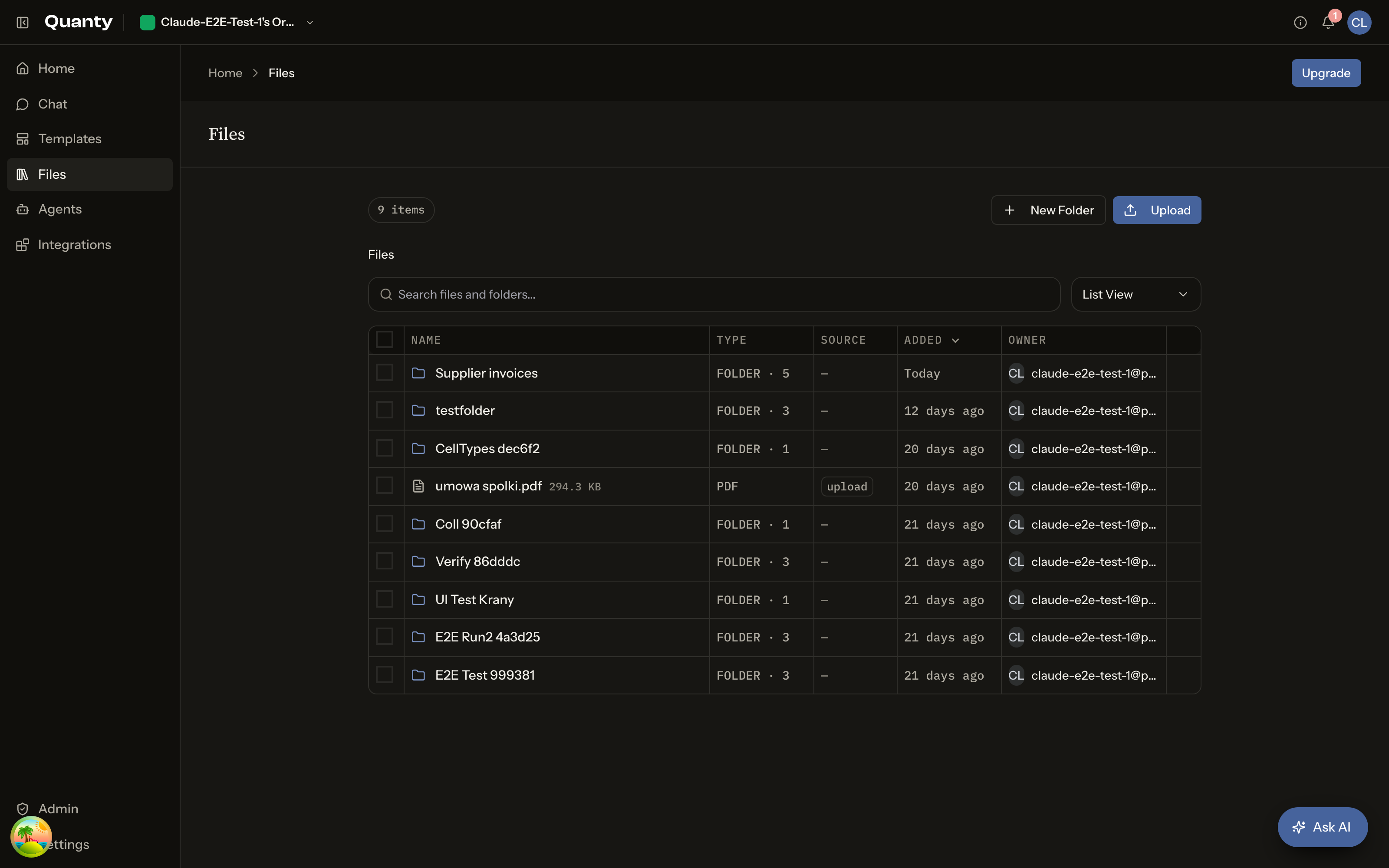
The Files page is your organization's document library. Everything you upload — contracts, invoices, reports, spreadsheets — is analyzed once and then available everywhere: as sheet rows, as chat context and as Knowledge Base standards for columns.
Uploading files
Open Files in the sidebar and use the upload modal:
- Drag and drop file here or click to browse, or use Choose File / Choose Folder to upload a whole directory.
- Uploads show real byte-level progress per file.
- File types are validated on selection, so unsupported files are filtered out before the upload starts.
- Upload limits are shown in the modal ("Up to N files / N MB per upload").
You can also add files directly from a sheet — the Add files toolbar button and drag-and-drop onto the grid both upload into the library and create rows in one step.
Processing and analysis
Files are analyzed after upload: text is extracted, tables are read row-aware, the content is indexed for search, and a summary is prepared. Each file shows its status:
| Status | Meaning |
|---|---|
| Processing | The file is queued or being converted |
| Analyzing | AI analysis and indexing are running |
| Ready | The file is fully processed and searchable |
| Failed | Something went wrong — retry from the file's menu |
Processing runs a limited number of files concurrently per user; additional files wait in the queue. Spreadsheet files (Excel, CSV) keep their row structure, so sheet-aware features can reference specific rows and tabs.
Organizing the library
- Create folders and nest them; the library also offers list, grid and tree views.
- Move and rename files and folders at any time.
- Deleting is a soft delete with a 30-day retention window. Owners and admins can permanently remove a file with force delete (for GDPR requests).
Downloads
Downloads use temporary signed URLs, so links expire and cannot be shared outside your organization. For many files at once, start a bulk download job and fetch the archive when it is ready.
Sharing and permissions
Each file has its own visibility, set from the share dialog:
- Everyone in the organization — the default for shared work.
- Only me — private to the uploader.
- Specific people — grant individual users or roles access, with Can view or Can manage per grant.
Files you cannot see never appear in your library views, sheets or chat retrieval.
Search
The library is indexed with hybrid search: semantic vector search combined with full-text search, merged into a single ranking. This powers:
- the search box on the Files page,
- chat retrieval — when you ask a question, the assistant searches your documents and cites what it used,
- enhanced filters (per file, per sheet tab, per row range) for spreadsheet files.
Knowledge Base
The Knowledge Base is not a separate place — it is a way to attach library documents to a column so the model judges against your standards instead of its own defaults.
In the column configuration, the Knowledge Base section lets you + attach documents (searchable picker) and remove them with a click. Typical uses:
- attach your pricing policy, then ask a column "does this contract deviate from our standard terms?",
- attach a compliance checklist and classify documents against it.
Standards stay current
The model rates against the attached documents, not its own defaults. Updating an attached document marks the dependent column stale, so you can recompute affected cells with one click.
Files in sheets
There are two ways to connect files and rows:
- Add files (toolbar) or drop files onto the grid — "Drop files to add rows". Each file becomes a row in the target File column.
- In the add-row modal, choose the target file column ("Add files to column") and pick the source: From Files (already in the library) or Upload New.
A cell can hold more than one file — a File set — and rows can carry extra reference files besides the main file column. See Columns & AI extraction for how file columns feed AI columns.
Related pages
- Workbooks & sheets — where rows live.
- Security & MFA — how file permissions fit the wider security model.