

Reviews & audit trail
AI-written values are only useful if you can check them, correct them and prove where they came from. Quanty gives every cell a review state, a locked "ground truth" mode, a refine loop for follow-up instructions, and an append-only audit trail with one-click restore.
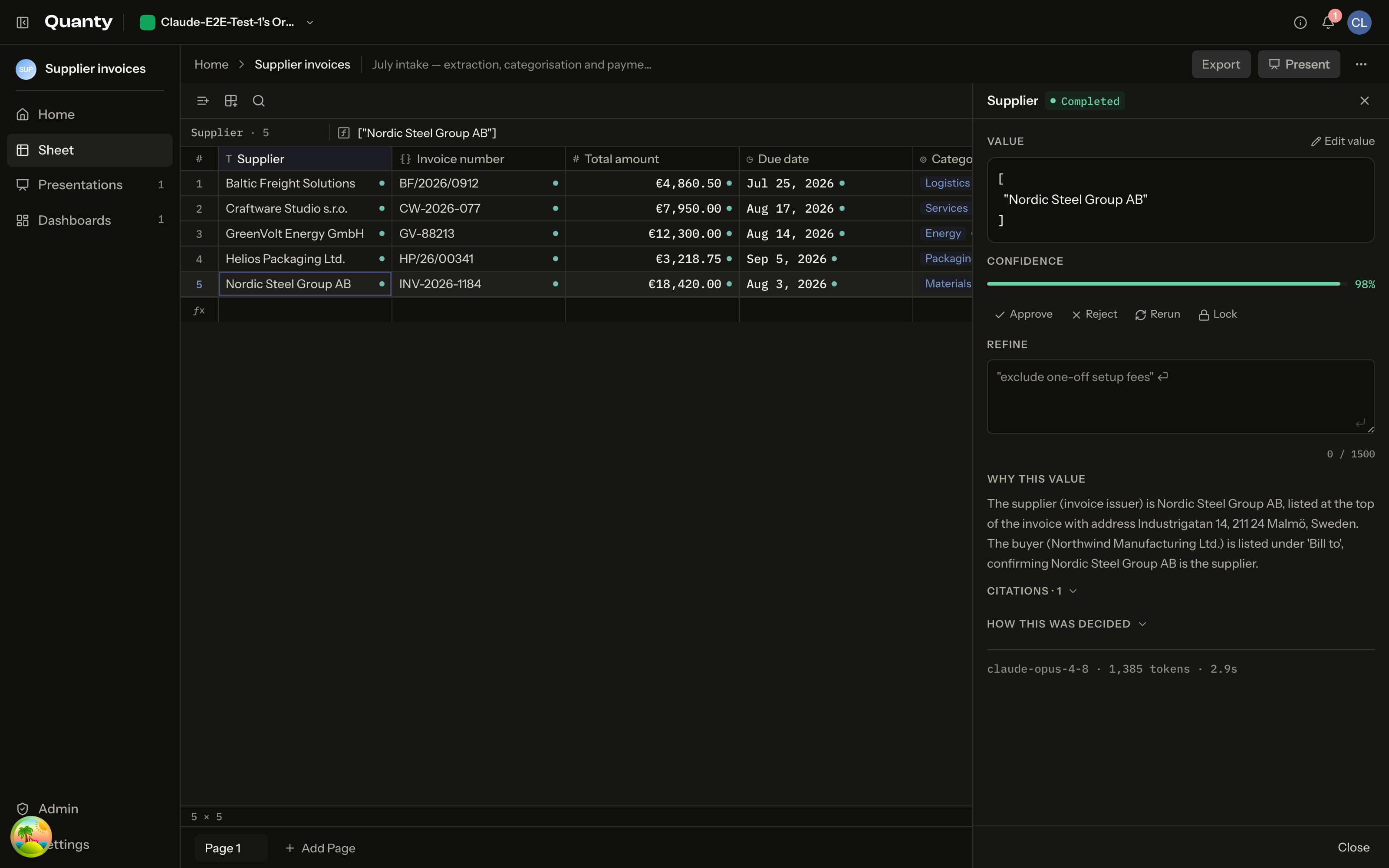
The cell detail drawer
Click into any AI cell to open its detail drawer. It shows:
- Live process — what is happening right now, if the cell is computing.
- Value — the current value.
- Why this value — the model's reasoning.
- Confidence — the model's confidence score.
- Citations — page chips linking to the exact places in the source documents, each with "Why this citation" and View in Document to jump to the highlighted region.
- Processing Details — tokens, cost, chunks, files used, model and processing time.
Reviewing cells
Every AI cell carries a review status: pending, approved or rejected. Use the Approve and Reject actions in the drawer, or review in bulk from chat. Whenever a new value is written to the cell, the status resets to pending, so approvals can never refer to a value nobody looked at.
Ground truth
Lock as ground truth freezes a cell's value. A locked cell is never overwritten:
- Reruns and refinements still compute, but the result is recorded as drift instead of replacing the value. The drawer shows a banner like "Rerun produced X — locked value kept".
- Formula application skips ground-truth cells.
- Unlock ground truth returns the cell to normal behavior.
Use ground truth for values you have verified by hand and want to protect from any future automation.
Refine
Refine re-runs the extraction with a follow-up instruction that applies to this run only, without changing the column's prompt. For example: "exclude one-off setup fees". The drawer keeps a History of past refinements.
Refine also exists column-wide from the column menu: the same follow-up instruction is applied to every cell in the column. Cells that are currently processing are skipped, and ground-truth cells record drift instead of changing.
The audit trail
The drawer section "How this was decided" lists every extraction run for the cell, newest first. Each run records:
- What triggered it: Run button, Automatic, Manual rerun, Refinement, Recompute (source changed), Approved by reviewer, Rejected by reviewer, Manually corrected, Restored earlier value.
- The inputs it read, by kind: Document, Row text, Column value, Knowledge base, External data, Previous value.
- The value it produced, its cost, and who or what initiated it.
Opening a run shows the full record: the column definition and prompt exactly as they were at the time, every context source with its relevance, and the raw model response.
Restoring an earlier value
Every run has Restore this value. Restoring writes that run's value back into the cell and resets the review status. The trail is append-only: a restore is recorded as a new entry rather than rewriting history. Restore is disabled while the cell is locked as ground truth.
Nothing is ever erased
The audit trail cannot be edited or truncated from the UI. Corrections, approvals, refinements and restores all append new entries, which is what makes the trail usable as evidence.
The review queue
Columns of type Single choice can act as validation gates: you pick which of their values route a row to human review (see Columns & AI extraction). The Review queue panel, opened from the grid toolbar ("Answers waiting for your approval"), collects those rows:
- Each card lists the row's problem columns with the extracted value (or
not found), the source page chip and the model's reasoning. - An inline input lets you type the correct value; pressing Enter writes it, marks the cell approved, and unblocks downstream columns that depend on it (they go stale and recompute).
- You can also open the full row or exclude it from the queue.
Related pages
- Columns & AI extraction — prompts, branches and review gates.